Check here at the beginning of each week for specific notes and instructions regarding the week’s assignments. New material will be added at the top.
Dear all: Great presentations in class yesterday! I love your creativity and imagination and enjoyed everything you brought to the table!
I wanted to post a traditional version of the Korean folk song “Arirang” so that you can appreciate Kwanwoo Kim’s wonderful arrangement in context.
I will be posting grades on Thursday; you can access them on Friday. Have a wonderful summer and I hope to see you in future classes!
MAY 16:
You will be presenting your final projects in class. Final projects must be emailed to me for grading by 11:59 PM.
MAY 11:
I am canceling class today due to illness. However, I have an assignment for you:
- Read “Rap on Trial,” Erik Nielson and Andrea L. Dennis
- Watch this recent speech that Atlanta rapper Killer Mike gave at a fundraising gala for the Foundation for Individual Rights and Expression (FIRE).
3. Write a response to the article and the speech, addressing the following questions:
– Should the rap lyrics of individuals charged with crimes be used as evidence against them? Why or why not?
– Do you agree with Killer Mike that the 1st Amendment should be broadly applied to protect ALL speech and expression, no matter how offensive? Why or why not?
Your answer should be 2-3 pages. Submit to me at oconnelljr@sunybroome.edu by Monday, May 15, at 11:59 PM. Put “Killer Mike” in the subject line.
REMEMBER YOUR FINAL PROJECT IS DUE ON MAY 16 AT 11:59 PM. YOU WILL BE PRESENTING YOUR PROJECT IN CLASS THAT DAY.
For May 9:
“How Hip Hop Holds Blacks Back,” John McWhorter
“When Hip Hop First Went Corporate,” Kyle Coward
First Draft of Final Project Document Due on May 4th at 11:59 PM!
For May 4:
Read:
“Hip Hop’s Ground Zero,” Fernando Orejuela
“The Story of Stagger Lee,” Timothy Lane
For May 2:
Read:
“Afrofuturism in Black Music,” Tony Bolden, and listen to the embedded sound clips.
For April 27:

Read:
“What We Want,” Stokely Carmichael
The Black Panther Party: A Graphic Novel History, David F. Walker and Marcus Kwame Anderson (excerpt)
“50 Years Later, Why ‘What’s Going On’ Endures,” Tonya Mosely and Samantha Raphelson
For April 25:
Read:
“Transgressive Leadership and Theo-Ethical Texts of Black Protest Music,” AnnMarie Mingo
Integrated Bus Suggestions, Dr. Martin Luther King, Jr.
From class on April 20: James Brown’s complete performance at the T.A.M.I. Show (1964) for those who want to see the whole thing — it’s amazing:
For April 20:
Read:
“Little Richard Set the Mold by Breaking It” (Spencer Kornhaber)
“The Possessed: James Brown in 18 Minutes,” David Remnick
For April 13:

Read:
“An Artist Speaks Bluntly,” Archie Shepp
April 11: CLASS MEETS IN THE LIBRARY
Librarians will be standing by to help with your final project research.
No reading assignments due.
If you revised your midterm and handed it in to me on April 4, I have graded it. I received very few revised midterms, and I still haven’t received everyone’s original midterm (due on March 16). Remember, the midterm is part of your final project, and the final project is 40% of your final grade.
April 6
Read:
The Birth of Bebop (excerpt), Scott DeVeaux
Revised Draft of Your Final Project Plan Due at 11:59 PM on March 30 April 4. This is your second draft, incorporating my revisions and suggestions on your midterm.
April 4:
Read:
“Souvenir of the Lost World of the New York Jazz Club,” Sean Wilentz
“Duke Ellington Explains Swing”
Wynton Marsalis, from Ken Burns’s Jazz, episode 1, on race:
March 30: Jazz Beginnings

Read:
Ten Basic Elements of Jazz, Langston Hughes
Primary source readings (these are all very short, I combined them into a single document):
“Sidney Bechet’s Musical Philosophy,” Sidney Bechet
“Whence Comes Jass?” Walter Kingsley
“The Location of ‘Jass,’” New Orleans Times-Picayune
“A ‘Serious’ Musician Takes Jazz Seriously,” Ernest Ansermet
“A Negro Explains ‘Jazz,’” James Reese Europe
“Jazzing Away Prejudice,” Chicago Defender
“The ‘Inventor of Jazz,’” Jelly Roll Morton
March 28:
Read:
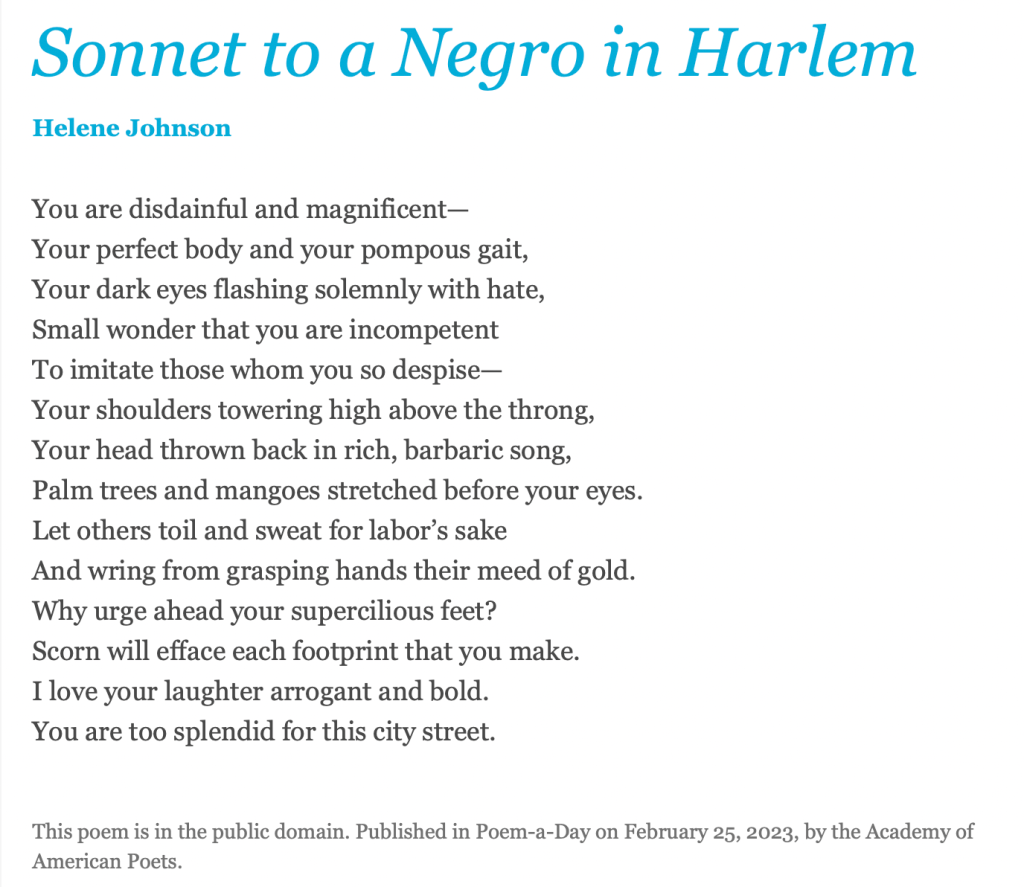
“History of a Song: Underneath the Harlem Moon,” Harlem World magazine
“Gladys Bentley: A Gender-Bending Blues Performer Who Became Harlem Royalty,” Giovanni Russonello (click on Read More to get the full article)
Spring Break/Midterms
If you turned in your midterm (due on March 16), I have graded and commented on it directly in the document, or in email.
If you have not turned in your midterm, and have not made arrangements with me to turn it in, your grade will be affected accordingly.
REMEMBER: YOUR MIDTERM PROJECT IS DUE ON MARCH 16 AT 11:59 PM.
From the “What If” page:
- March 16, 11:59 PM: Submit a written first draft of your idea/plans to me. This is your midterm assignment.
Your draft should include:
– A narrative of the alternate-historical event
– How this event would have affected Black music
– A draft plan for your “document”
– A draft bibliography of sources you have consulted/are consulting in Chicago style
Email your midterm draft to me at oconnelljr@sunybroome.edu.
For March 16: Black Sacred Music in the 20th and 21st Centuries
Read:
“Afro-Christian Music and Religion,” LeRoi Jones
“How the Black Church Fueled a Movement,” Maggie Phillips
Great Twitter thread on different regional and denominational gospel styles (a couple of spirituals in the mix too):

For March 9, Read:
“It’s Time to Let Classical Music Die,” Nebal Maysaud
“Trailblazing Composer Julia Perry on Music as the Universal Language of Love and Mutual Understanding,” Maria Popova
Optional: “Beethoven As A Black Composer”
For March 7: Black Performers in Classical Music Traditions
I heard some great ideas yesterday in our library session! I’m excited for what you all are bringing to the table!
Remember, that in order to be able to convincingly create a counterfactual, alternative history, you need to know the actual, real history. What really happened? In your “what if,” how did it happen differently?
Read:
“Roland Hayes: Expressor of the Soul in Song,” Marva Griffin Carter
Listen:
Episode #51, “As White As Classical,” from the podcast How Music Does That
CLASS MEETS IN THE LIBRARY ON MARCH 2
Read and listen to the embedded music examples in the following blog post:
For February 28:
Read:
“The Ballad of Geeshee and Elvie: On the Trail of the Phantom Women Who Changed American Music and Then Vanished Without a Trace,” John Jeremiah Sullivan
This is a long article with embedded listening examples. Read and listen to all of it!
“A Song That Changed Music Forever,” David Hajdu
Optional:
Watch an excerpt from the documentary “How Britain Got the Blues” (I mentioned the blues revival in England briefly in class):
For February 23:
Cameron, José, and Eli will be playing blues scales.

Everyone read:
Letter to the Chicago Defender, May 13, 1917
And this Twitter thread:
For February 21:
Optional — this is breaking news, and it’s about what we were talking about in class on Thursday!
“Progressive Group Roiled By Accusations Diversity Leader Misrepresented Her Ethnic Background,” Alice Speri
Secular Folk Song: The Blues
You already know about spiritual folksongs. The blues, perhaps the most important genre of popular music in world history, is secular folksong — that is, it’s about daily life, the fallen world, and all of its struggles.
As novelist Ralph Ellison wrote:
“The blues is an impulse to keep the painful details and episodes of a brutal experience alive in one’s aching consciousness, to finger its jagged grain, and to transcend it, not by the consolation of philosophy but by squeezing from it a near-tragic, near-comic lyricism. As a form, the blues is an autobiographical chronicle of personal catastrophe expressed lyrically.”
Read:
“The Blues: A Secular Spiritual,” James M. Cone
“The Blues Mode and the 12-Bar Form,” Peter van der Merwe
(This reading has a lot of technical musical language and musical examples. If you can read music, try to play through some of them on the keyboard or on your instrument. If you can’t read music, just scan the text for a sense of the musical language commonly used to describe the blues.)
Listen:
Robert Johnson, “Cross Road Blues,” supposedly his account of selling his soul to the devil to learn how to play guitar.
Robert Johnson, “Preachin’ Blues”:
Blind Willie Johnson, “Dark Was the Night”:
For February 16:
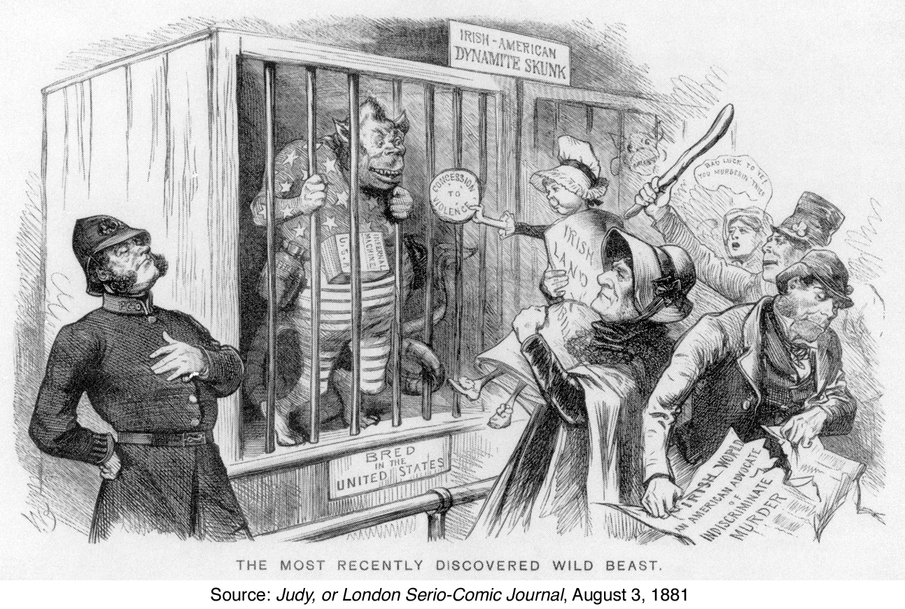
To contextualize the racist visual stereotypes in the sheet music of minstrel songs, take a look at similar depictions of Irish, Jewish, Italian, and Chinese immigrants from nineteenth-century newspapers.


Read:
“Before it Goes Away: Performance and Reclamation of Songs from Blackface Minstrelsy,” Sheryl Kaskowitz
Optional:
In Columbia [S.C.], Artist John Sims Looks Back on 20 Years Transforming the Confederate Flag,” Jordan Lawrence
“Soprano Withdraws from Opera, Citing Blackface in Netrebko’s Aida,” Javier C. Hernández
For February 14:
Content warning: We are moving into a particularly disturbing period in Black American music history. Blackface minstrelsy is a primary source and continuing location of some of the most offensive visual and sonic tropes of American racism. Please be advised that in this unit, you will see and hear many offensive and disturbing images and offensive language.
Read:
What is Blackface?, p. 19-34 and 98-112, Ayanna Thompson
“A Brief Guide to 21st-Century Blackface,” Aisha Harris
For February 9:
No reading for today’s class. Use the time to catch up on missed reading.
We are meeting in the library for a tutorial on carrying out the research for your final project.
For February 7:
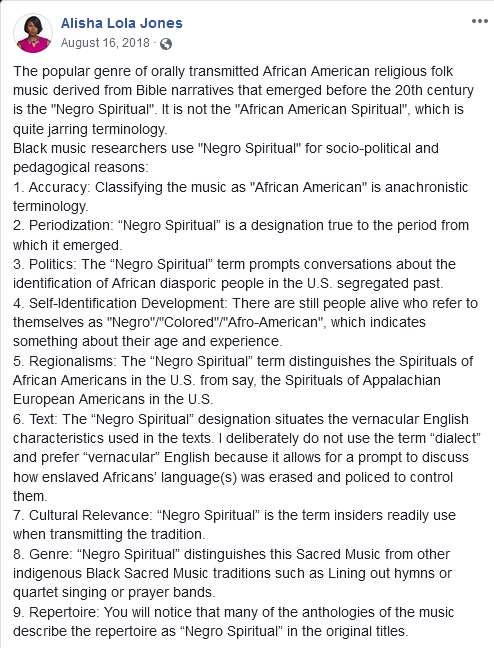
Dr. Alisha L. Jones explains why the repertoire of spirituals is referred to as “Negro Spirituals.”
Read:
“The American Folk Song” (excerpt from The Gift of Black Folk), W.E.B. Du Bois
“These Young Singers Still Carry the Torch of Black Freedom,” Margaret Renkl
Note: the second article is from the New York Times. To read it, you need to sign up for a FREE New York Times subscription through the SUNY Broome Library. To do so, go to https://sunybroome.info/library/databases-by-title/n and scroll down to New York Times Digital Edition. Directions in this screenshot:

For February 2:
Read:
“Through the Prism of Folklore: The Black Ethos in Slavery,” Sterling Stuckey (1968).
This is a pioneering essay by a Black historian about the folk culture created by enslaved people (including music), which allowed them to “free themselves” within the institution of slavery. Keep what Stuckey says in mind as we go forward through the semester and explore the ways that Black music is a place of joy and healing amidst violence.
Remember that happiness is a form of resistance.
For January 31: Three things.
- Read through the Final Project page.
- Click through to all the links.
- Watch all video and listen to all audio.
- Write down all the dates from the timeline in a planner or put them in a calendar app.
2. Read “Some Fundamentals of African Music,” Peter van der Merwe (this has technical musical terms and some music notation examples)
3. Browse “Musical Passage”: A website dedicated to the earliest known pieces of African music in the Americas. The pieces were transcribed in a 1707 book called Voyage to the Islands of Madera, Barbados, St. Christophers, and Jamaica, known as the “Hans Sloane Document.” Hans Sloane was a British naturalist who went to Jamaica in 1687 as physician to the British governor of Jamaica. He included several West African songs, which he heard enslaved musicians play on his trip, in his book (it is thought that the music was transcribed for him by an enslaved man who had been trained in Western music notation).
If you have any questions, comment on this post.
A little message to you. Not safe for work or kids but 100% true.
First class: Defining our terms, syllabus explained, what to expect
We will be thinking about the questions:
- What is Black music?
- On a more fundamental level, what is Blackness?
- What is “race”? Who defines what race is? Who defines what culture is?
- Are there a limited number of recognized/accepted ways that one may express one’s race and/or culture? Or are the ways that people of a given group may engage in cultural expression infinite?
- What does it mean to be an American (of any color)?
Keep these questions close. They will be the basis for everything we study this semester!
For January 26 class, please read the linked blog post, below. (Click on the title “Blackberry Fool” to take you there.)
Watch the embedded videos, and click on ALL the links. Your Question of the Day will be on these readings!
 From Spirituals to Hip Hop MUS 113 SUNY Broome